Nick Shoulders Turns Country Music Into a Survival Tool
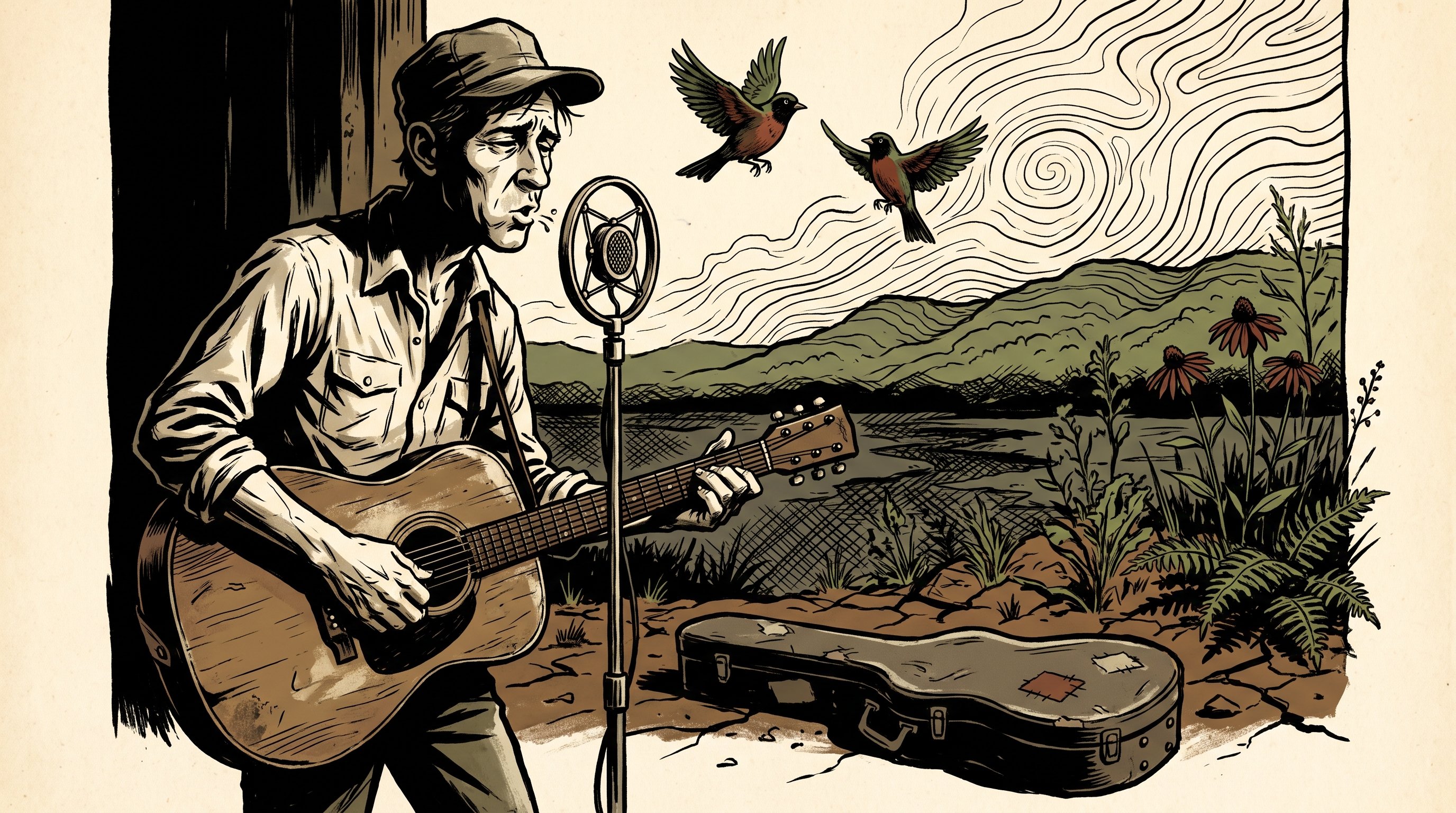
A punk record does not need a distorted guitar. Sometimes it needs one ribbon microphone, an acoustic instrument, a bird-call whistle, and absolutely no interest in country music’s approved script.
That is the useful tension inside Nick Shoulders’ Refugia Blues. The Arkansas songwriter’s fifth album is rooted in Southern traditional music, but it is not an exercise in polishing old forms for a heritage festival. It is a solo record about climate collapse, place, justice, love, and what survives when the systems around us stop pretending to be stable.
This is the Punk Lineage lane in its purest form: the sound reaches backward, while the nerve comes straight out of the heavy-music underground.
The Punk History Is Not Decorative
Shoulders did not arrive at country music through a branding meeting. The biography for his previous album, All Bad, traces a childhood full of family singing, bird-call whistles, and Southern gospel into an adolescence spent drumming in metal and punk bands. He also worked as an illustrator and participated in Arkansas’s heavy-music scene before diving deeper into the rural music of his home region.
That path matters because it explains why his country music rarely feels obedient.
A lot of crossover stories get reduced to wardrobe: here is the punk kid, now wearing boots; here is the country singer, now playing louder. Shoulders’ connection runs deeper. Punk taught him that tradition is material, not a set of museum rules. You can learn the language, understand where it came from, and still use it to argue with the present.
His whistle, yodel, croon, and field-holler textures are old tools. The questions he puts through them are not safely antique.
Turning Off the Amp Can Still Be Confrontational
The central move on Refugia Blues sounds like a retreat from force: Shoulders turns off the amp, stands alone at a ribbon microphone, and records live to tape. The Bandcamp credits say the sessions happened at Homestead Studios in Fayetteville in January 2024, with Shoulders handling the production, album art, and every instrument.
That is not less punk than a loud band. It is a different kind of exposure.
Recording live to tape means the performance has to carry its own weather. There is less room to hide the breath, the scrape, the odd edge of a note, or the physical comedy buried inside a vocal turn. The record’s strength comes from committing to those details instead of sanding them into tasteful Americana wallpaper.
DIY can mean a basement four-track or a photocopied seven-inch sleeve. Here it means one person taking responsibility for the sound, the playing, and the visual object, then releasing it through Gar Hole Records—the independent Fayetteville label he co-owns. The means are traditional. The control stays close to the artist.
Refugia Is the Right Word
A refugium is a place where life persists through a period of major change. That makes Refugia Blues more than a clever title. It is a working idea for the whole record.
The official album description points directly at climate collapse, radical anthropology, and generative disruption. Those are large subjects, but the music does not approach them like a lecture stapled to a folk record. It puts the planetary beside the personal. Love songs, humor, grief, Southern identity, and ecological anxiety share the same small acoustic room.
That scale-shifting feels especially sharp in country music. The genre is excellent at making a road, a family story, a ruined field, or a hometown carry more weight than its physical boundaries. Shoulders uses that old intimacy to ask what a home means when the climate is changing underneath it—and who gets protected when the pressure arrives.
The album’s dedication makes the politics plain without turning them into merch copy: it is for “any and all struggling for justice in a changing world.” That sentence could sit on a benefit-show flyer. On this record, it sits beside live tape, Southern song forms, and a voice that can move from croon to yodel without asking permission from a format committee.
Old Sounds Do Not Belong to Reactionaries
One of the quietest radical ideas in Nick Shoulders’ music is that traditional country does not have to be surrendered to nostalgia merchants.
The trucks-and-beers version of modern country often treats “the past” as a fenced property: stable gender roles, stable hierarchies, stable weather, stable myths about whose South counts. Refugia Blues refuses that deal. It reaches into older musical vocabulary while talking about a world defined by instability and collective consequence.
That is where the punk DNA becomes more than biography. Punk’s best habit is not simply opposition; it is reclamation. Take a room, a machine, a printing method, a three-chord song, or a neglected local history and make it useful to people who were not invited into the official version.
Shoulders does that with country tradition. He does not mock it from outside. He knows it closely enough to separate the living material from the conservative display case.
The Artwork and the Whistle Belong to the Same World
The visual hook here is unusually specific: one performer at an old microphone, acoustic wood and tape machinery in the foreground, with birds and a changing Southern landscape pressing in around the edges.
That image fits because Shoulders’ work has never divided neatly into “serious songs” and decorative eccentricities. The bird calls, illustration, humor, yodeling, road-worn presentation, and ecological themes are all ways of refusing the standardized package. They make the music feel inhabited rather than optimized.
Even the track titles—“Apocalypse Never,” “Bored Fightin’,” “Hill Folk,” “Dixie Be Damned”—suggest a record that can hold dread, regional argument, and a crooked grin at the same time. The point is not novelty. The point is building a complete language from whatever the artist actually knows.
That is a durable punk lesson, especially in roots music: specificity beats posture.
Country Music as a Place to Keep Living
Refugia Blues was released October 31, 2025, but its argument is not tied to a release-week cycle. It asks an older and harder question: what parts of culture can help people remain human during change?
For Shoulders, the answer seems to include inherited singing styles, independent infrastructure, humor under pressure, attention to place, and the freedom to put radical questions inside familiar forms. None of that requires country music to become punk rock. It requires country music to remember that tradition was made by people adapting to the world—not by gatekeepers freezing it.
That is why Nick Shoulders belongs in this rotation. He did not trade punk for country. He carried the scene’s self-determination into an older sound and found another way to make it confront the present.
What other roots artists are using traditional sounds not to escape the future, but to build a place where something honest might survive it?
Got thoughts? Hit me up on Bluesky.
Sources: