Vintage Story Makes Survival Feel Handmade Again
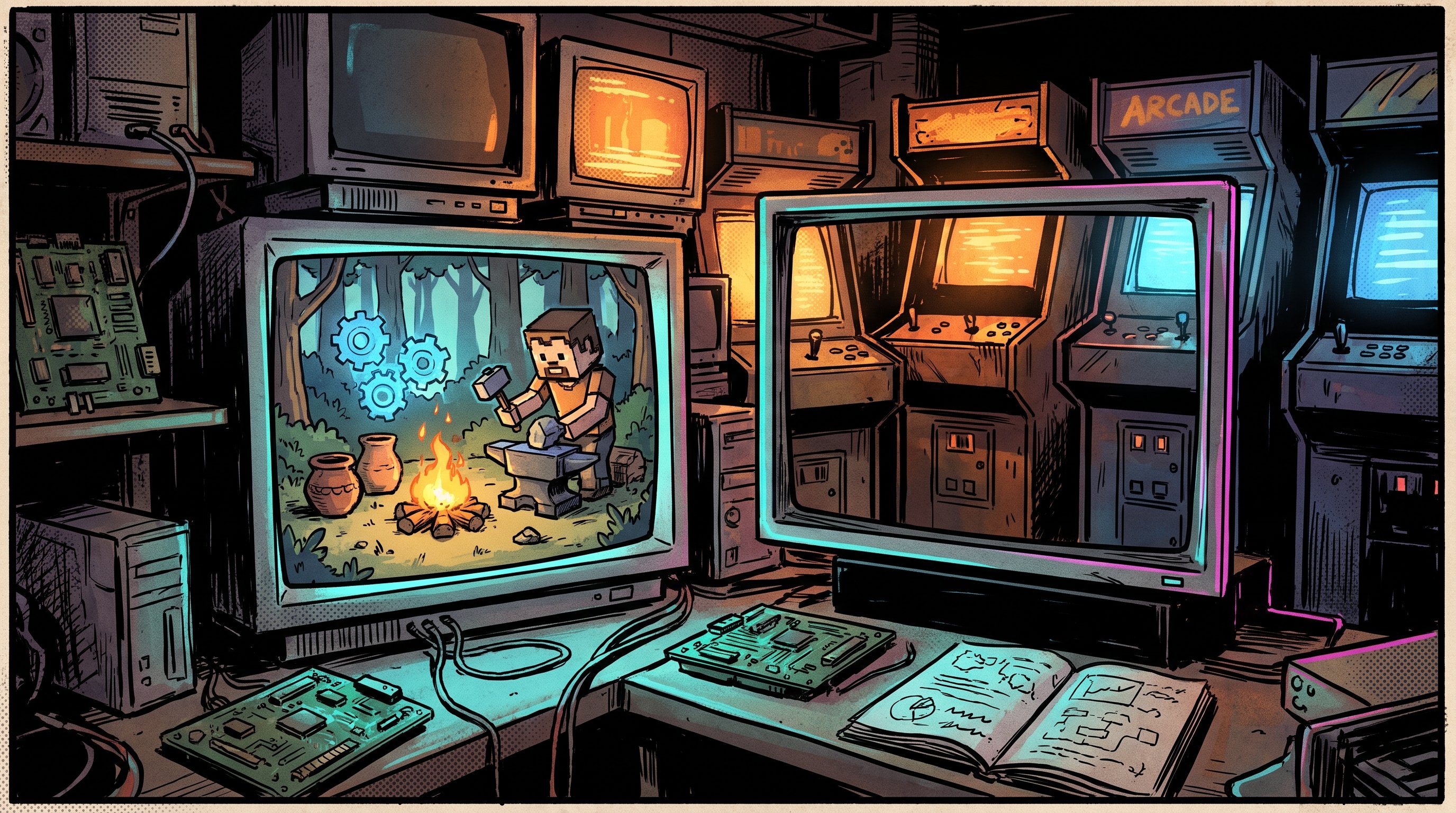
Some survival games make you punch a tree so the tech tree can start handing out receipts.
Vintage Story is weirder, slower, and better than that. It wants the first tool to feel like something you actually made, not something the UI blessed into existence. You knap stone by removing little pieces from a surface. You worry about seasons. You learn what the ground is made of. You look at a clay pot, a copper ingot, or a working windmill and feel the tiny miracle of having crawled there from nothing.
That is why it fits the Lemmy’s Mic indie-games lane so cleanly. This is not just “survival crafting but harder.” It is a game about player agency at the dirt-under-the-fingernails level: rules you can tune, systems you can learn, and a mod scene that treats the game like a workshop instead of a sealed product.
The Fun Is in the Friction
Vintage Story’s official pitch calls it an “uncompromising wilderness survival sandbox,” and that word matters. Uncompromising does not mean hostile for the sake of being hostile. It means the game trusts friction to create memory.
The first-day loop is a good example. The wiki does not describe a breezy checklist; it walks new players through health, hunger, temporal stability, inventory limits, waypoints, and stone knapping. That sounds like a lot because it is a lot. But the density is the point. You are not just unlocking a pickaxe icon. You are learning a grammar: where flint comes from, why stability matters, how hunger changes decisions, and why a bad campsite can become a long-term problem.
That kind of friction is risky because it filters out people who want instant flow. But for the right player, it creates a deeper kind of attachment. The world feels less like content and more like a place that grudgingly lets you understand it.
Settings Are Part of the Design
The player-agency angle gets even stronger when you look at world configuration. Vintage Story lets worlds be customized through the creation menu, adjusted later, or changed with commands. The wiki’s configuration page gets wonderfully granular: death punishment, spawn radius, temporal gear respawns, seasons, grace timers, player lives, and a pile of other knobs.
That is the difference between difficulty as branding and difficulty as a conversation.
A survival game can say, “Here is the intended suffering.” Vintage Story is more interesting because it says, “Here are the pressures. Decide what kind of story you want them to produce.” Want the hard winter? Keep it. Want a gentler start so you can focus on building and metallurgy? Tune it. Want multiplayer rules that reduce grief and increase cooperation? The game is already thinking about that as part of the experience.
The punk-DIY connection is right there. The best sandbox games do not just give players freedom inside the rules. They give players some authority over the rules themselves.
Modding Is Not an Afterthought
Vintage Story also has the kind of mod culture that makes a game feel alive between official updates. The official mods hub is not a random pile of downloads off in the weeds; it is presented as a central place for community-made modifications, tied to the player’s game account and built to simplify discovery.
That says a lot about the game’s posture. Modding is not treated like a nuisance or a loophole. It is part of the expected life of the thing.
The official site is explicit about this, too: the game was built from the ground up with modding in mind, with its own API, and it even points to open-source modeling and animation tools. That is the good stuff. Not because every player needs to install 40 mods before breakfast, but because moddability changes the social contract. It tells the community: if you see a gap, build into it. If you want a different texture, mechanic, structure, or quality-of-life tweak, you are not trespassing.
That is how long-tail indie games survive. They become places where players keep making the game more specific than any roadmap could have predicted.
Updates Still Matter, But the Community Carries the Spark
The official news page shows the other half of the equation: Vintage Story is still moving. Recent update titles talk about auction house upgrades, server safety patches, fishing, mechanisms, metalworking, and more. That kind of continuing development gives the mod scene something solid to orbit.
But what makes the whole thing click is the relationship between official depth and community invention. The base game already cares about seasons, soil, rock strata, weather, metallurgy, and survival pressure. Mods can then push sideways instead of having to repair a hollow center.
That is why Vintage Story feels handmade even when the systems get huge. The game has craft in both senses: the in-game act of making useful things by hand, and the developer/community act of treating the game itself as something shaped over time.
The Sandbox That Hands You Tools, Not Answers
Vintage Story is not for everybody, and that is part of its charm. It asks for patience. It makes knowledge feel earned. It lets the first campfire, first tool, and first stable home carry more weight than another flashy loot drop.
In a genre crowded with checklist survival, that feels almost rebellious. The game does not flatten the world so you can consume it faster. It gives you material, pressure, and enough control to make your own version of surviving.
That is the indie-games sweet spot: a game as a framework, a community as co-author, and a player who gets to feel like more than a tourist passing through someone else’s systems.
What other survival games still make you feel like you are learning a world instead of merely clearing objectives?
Got thoughts? Hit me up on Bluesky.
Sources: