Big Walk Gets Why Co-Op Works Better When Talking Is the Mechanic
A lot of co-op games say they are about teamwork when what they really mean is that four people can stand in the same place and spam different abilities at the same boss.
That can still be fun. I am not above a good chaos pile. But the co-op games that really stick with me usually understand something more specific: working together gets interesting when communication is not just support for the game, but part of the game itself.
That is the big reason Big Walk has my attention.
House House describes it as a “cooperative online walker-talker,” which is already a much better pitch than the usual genre sludge. The official site and Steam page both frame the game around wandering a big world with close friends, getting lost, making discoveries, and solving puzzles together. PC Gamer’s review pushes that further, calling it a thoughtful puzzle game that takes co-op communication to new levels.
That sounds exactly like the kind of design choice I want more indie games to chase.
Distance Is Not a Problem Here, It Is the Point
One of the smartest things about Big Walk is that it seems committed to distance as a mechanic instead of treating it like an inconvenience.
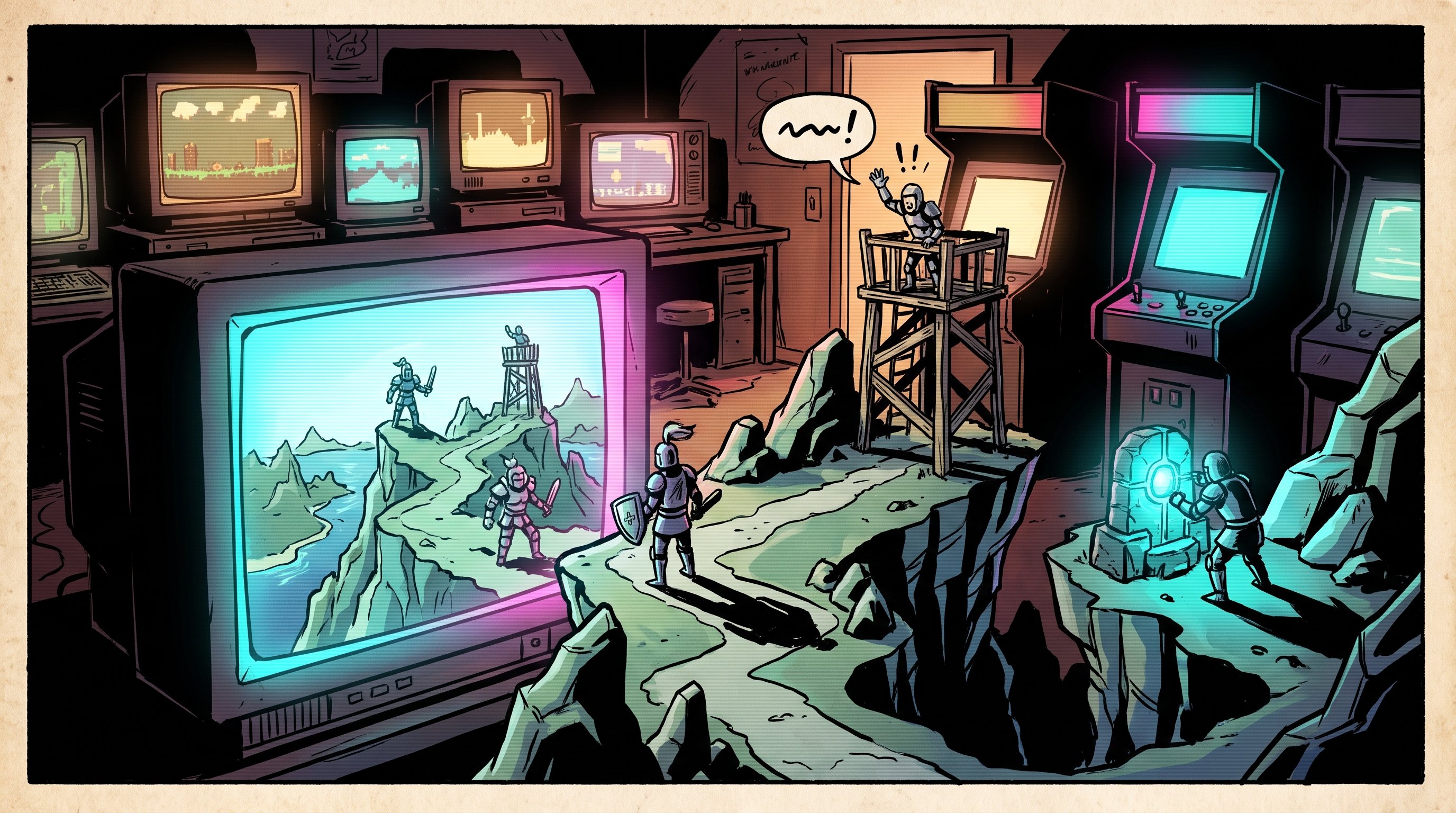
PC Gamer’s write-up about the game’s communication design makes the case bluntly: if you shortcut the experience by using Discord instead of the built-in proximity chat, you rob the game of a lot of its creative problem solving. I love that. It means the awkwardness is intentional. The uncertainty is intentional. The moment where one friend is yelling from across a ridge while another is waving from a tower is not a failure of convenience. It is the puzzle space.
That changes the emotional texture of co-op in a really satisfying way. Instead of perfect information, you get partial information. Instead of everybody behaving like one shared brain on voice comms, you get little bursts of confusion, misdirection, and eventual clarity. That is where memorable stories usually come from anyway.
A lot of modern multiplayer design is obsessed with smoothing everything down. Big Walk seems more interested in asking what kinds of fun show up when players have to bridge gaps themselves.
The Gentle Tone Makes the Design Hit Harder
Another thing I like is that the game does not appear to lean on stress to create cooperation.
The official pitch is all challenges, puzzles, discoveries, and hanging out with your friends in a wide-open world. PC Gamer’s review describes it as a joyous jaunt through a gentle environment full of thoughtfully designed puzzles. That softer tone matters. It means the game can make communication feel important without wrapping everything in panic, punishment, or survival-game busywork.
There is something refreshing about a co-op game that trusts people to find tension in orientation, timing, and interpretation instead of constant combat alarms. You do not need a horde bearing down on you to make communication meaningful. Sometimes it is enough to have one player notice something strange, another player mishear the clue, and a third person try to translate the whole mess into a solution.
That kind of friction feels human instead of mechanical.
It Also Knows Co-Op Can Be Exclusionary
The one slightly mean thing about Big Walk may also be one of the things that makes it so distinct: it sounds built very specifically for actual friend groups.
PC Gamer’s piece on whether you can play alone or with randoms calls it one of 2026’s most adored co-op games while also noting that it is a rough proposition for loners. Normally that would sound like a drawback. And for some players, it absolutely is one.
But as a design statement, I kind of respect it.
Not every multiplayer game needs to flatten itself into universal accessibility for every play style. Sometimes a game becomes sharper by knowing exactly what social situation it is for. Big Walk does not seem like it wants to be an all-purpose online service that accommodates every possible arrangement of strangers. It wants to create a very particular feeling: being out in a weird, beautiful place with people you know well enough to misunderstand productively.
That is a narrower fantasy, but it is also a stronger one.
This Is the Sort of Specificity Indie Games Are Great At
The best indie games often win by getting weirdly precise about one sensation and then building everything around it.
In this case, the sensation is trying to stay coordinated when the world keeps pulling your group apart just enough to make every answer feel earned. Not because the systems are cruel, but because the design understands that talking, searching, regrouping, and pointing at things are already forms of play.
That is what makes Big Walk more interesting to me than a lot of bigger, louder co-op releases. It is not just offering a place for four people to be busy together. It is building a whole game around the fragile, funny process of trying to make yourselves understood.
And honestly, that may be one of the most reliable ways to make co-op feel alive: give players a world big enough that they cannot help needing each other.
What is your favorite multiplayer game that understands communication is part of the fun, not just a tool for optimizing it?
Got thoughts? Hit me up on Bluesky.
Sources:
- Big Walk by House House
- Big Walk on Steam
- Big Walk review: A thoughtful puzzle game that takes co-op communication to new levels - PC Gamer
- Communication is the biggest puzzle piece in chill co-op game Big Walk, so don’t take any shortcuts by using Discord - PC Gamer
- Can you play Big Walk alone or with randoms? - PC Gamer