Battery Swapping Is the Most Grown-Up Thing Happening in Micromobility
A lot of micromobility coverage still treats the scene like a spec-sheet arms race.
More range. More torque. Faster charging. Bigger numbers everywhere.
I get it. I love weird hardware too. But the older this whole space gets, the more I think the real breakthrough is going to look a lot less sexy: not another slightly hotter motor, but better battery logistics.
That is why the recent battery-swapping and battery-safety stories feel bigger than they might look at first glance.
The Interesting Part Is Not the Gadget
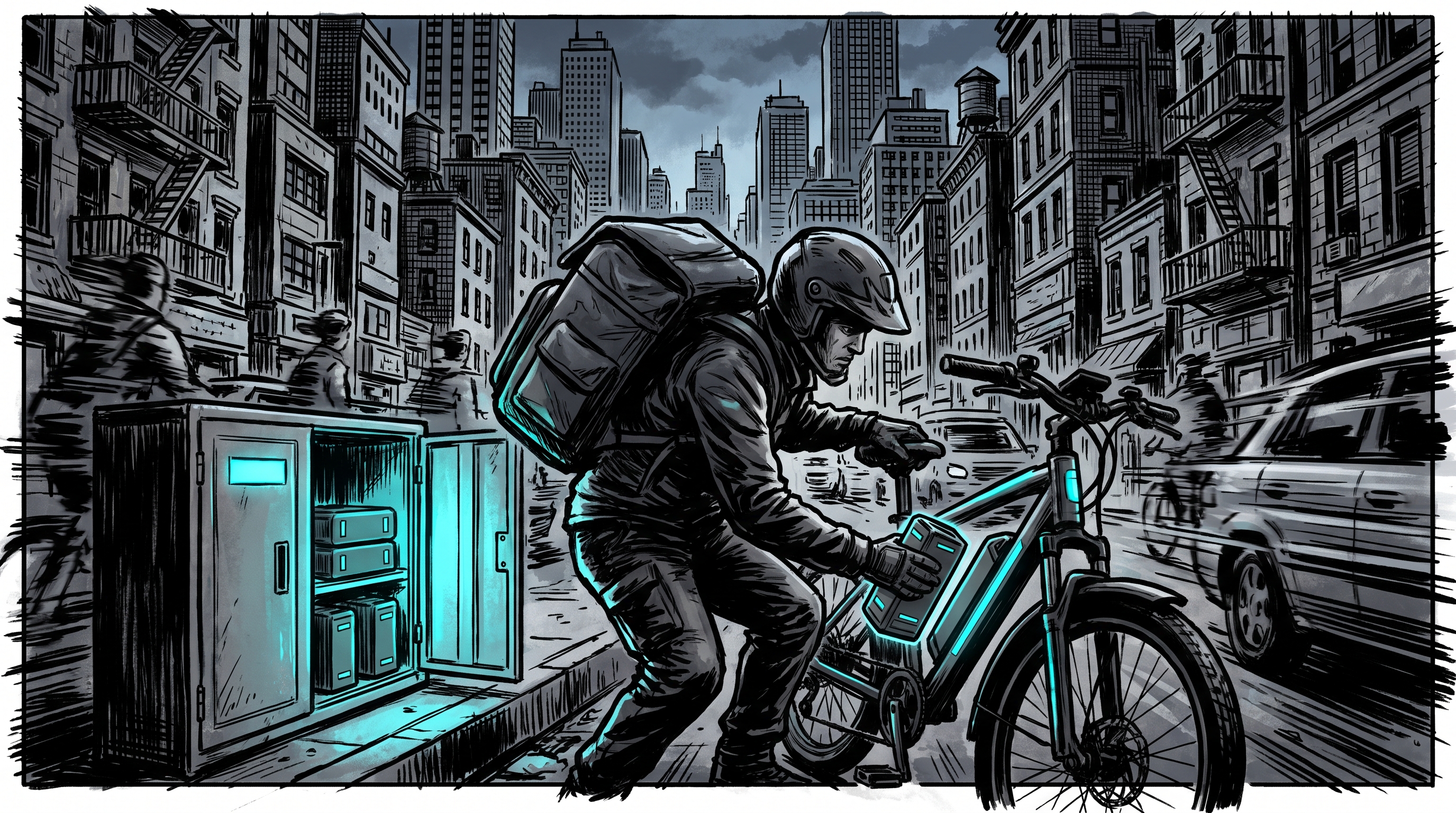
New York City launched a public process this spring for roughly 25 e-bike battery swapping cabinet locations, aimed in part at riders who need a practical way to keep moving without hauling multiple packs around all day. That matters because it treats batteries as infrastructure instead of a private inconvenience. If you can safely swap a dead pack for a charged one in the course of a workday, the vehicle stops being a fragile little island and starts becoming part of a real system.
That is a much more mature vision than the usual “just charge it at home somehow” shrug.
It also lines up with what manufacturers keep inching toward. Electrek’s coverage of Yamaha’s new Aerox-E scooter notes the machine uses two removable 1.5 kWh batteries, which is exactly the sort of practical design choice I want to see more of. The annoying part is that the packs do not seem to fit an actually unified swappable standard, even though that would be the obvious next step.
So we are in this awkward middle phase where the industry clearly understands removable batteries are useful, but still has not fully committed to making the ecosystem interoperable.
Safety Rules Are Becoming Design Rules
The other big signal is regulatory, and for once I do not mean some lazy crackdown headline.
The National Law Review summarized the CPSC’s proposed federal lithium-ion rules for micromobility this month, and the scope is telling. The proposal reaches beyond complete vehicles into replacement battery packs, aftermarket chargers, and even e-bike conversion kits. It leans on existing UL standards, but also adds tougher expectations around tamper resistance, charging behavior, reverse-polarity protection, warnings, and consumer instructions.
That might sound boring compared to a flashy launch, but boring is good here.
A healthy scene needs parts people can trust, chargers that are less likely to become improvised hazards, and battery systems that do not force every rider into a DIY risk-management job. The homebrew spirit is still important. I am never going to stop loving the tinkerer side of e-bikes and PEVs. But there is a difference between mod culture and a market that quietly offloads basic safety onto the end user.
The Future Probably Looks More Like a Utility Than a Toy
What keeps sticking with me is that all three threads point in the same direction.
Cities want safe public charging and swapping. Regulators want better baseline battery systems. Manufacturers want the convenience of removable packs because they know not everybody has easy garage charging.
That adds up to a version of micromobility that is less about one perfect machine and more about whether the whole surrounding setup actually works in daily life.
Can you charge safely if you live in an apartment? Can a delivery rider finish a shift without juggling sketchy batteries? Can a commuter replace a pack without entering some proprietary dead end? Can the industry build standards that still leave room for experimentation?
Those are the questions that matter now.
The coolest future for e-bikes and small electric vehicles might not be the one with the wildest headline numbers. It might be the one where the batteries are easier to remove, safer to charge, simpler to replace, and eventually interchangeable enough that riding stops feeling like a bespoke workaround.
Honestly, that sounds like progress to me.
If micromobility is going to grow up, would you rather the next big leap be faster machines, or better battery infrastructure?
Got thoughts? Hit me up on Bluesky.
Sources:
- Mayor Mamdani Invites New Yorkers to Weigh in on Locations for E-Bike Battery Swapping Cabinets Across New York City - NYC Mayor’s Office
- Electric Scooters and e-Bikes: CPSC Proposes Lithium-Ion Battery Restrictions - The National Law Review
- Yamaha launches sporty Aerox-E electric scooter with removable batteries - Electrek